
Every so often I get looking at stuff online and find some pretty intriguing info. It's the Internet after all, and should come as no surprise. The neat thing is that you can assemble a pile of stuff and look at it side by side, like comparing washing machines or melons at the market.
So since I usually have a today in history thing or who died on this date post I was getting stuff together and realized that December 12 had some pretty awesome and shitty music hit the charts then.
How about Dec 12, 1957 when Presley had Jailhouse Rock and Buddy Holly had Peggy Sue. Parents all over North America learned how to yell `Turn that goddamn racket down!`
Or 1965 when Turn, Turn, Turn by the Byrds and I Got You (I Feel Good)by James Brown made the charts. Wow.
But you gotta have some balance too. 1973 had the Carpenter`s Top of the World and in 1981 (brace yourself) Physical from Olivia Newton-John. Sorry.
And here`s one, not a song, but still big news: the Chairman of the Board, Francis Albert Sinatra, was born this day in 1915.
To finish up and totally unrelated because I`m in a mood tonight, I watched (for the 3rd time) last night on PBS, the Buena Vista Social Club. Superb.
Wednesday, December 12, 2007
December 12 in music history.

Tuesday, December 11, 2007
Use the fork, Luke.

It surprises me that during the late 50's when the first space shots had captured the public imagination and the cold war and all it's technological sabre rattling held the generals gaze, that somewhere, someone didn't put the pieces together and come up with a space video game. It seems obvious that the public would go for it. There was such a game, much heralded in programming circles, but rarely seen outside of the engineering department at MIT, called Spacewar! (don't forget the exclamation point)
Conceived by Steve Russell, Martin Graetz and Wayne Wiitanen to run on the Digital Equipment Corporation PDP-1, which came out in 1960. It boasted a whopping 9 K of memory and became notorious as the first computer to elicit the hacker mentality in computer science students. Back in 1960 hackers were the crazy into computer people, rare animals indeed in a world of less than a thousand computers. The idea of constant debugging and upgrading to improve performance can be blamed on them.
The three formed the Hingham Institute (named after the street their house was on) to study how to take advantage and exploit the limits of the PDP-1. The result of their toils was Spacewar! They wanted to "demonstrate as many of the computer's resources as possible, and tax those resources to the limit", "it should be interesting, which means every run should be different" and "it should involve the onlooker in a pleasurable and active way -- in short, it should be a game."
The game was simple; as the best games usually are. Two competing spaceships maneuver and shoot at each other, dodging and weaving to avoid being hit against a background of moving stars. Early versions had random dots, while later ones had actual correct star charts moving along. Originally control was via the computer's input controls, but that was a real snarl for 2 players to get at and one player was always farther from the screen, a decided disadvantage. Since joysticks were not available then they designed a simple Bakelite control box and had the institutes model railway club bodge them together.
The program was ready in April 1962 for MIT's annual Science Open House in May. At the end of the academic year the MIT hackers moved on to professional careers around the country. For a fun first hand account of the birth of this game I dug up this article written for long gone (1985) Creative Computing Magazine. http://www.wheels.org/spacewar/creative/SpacewarOrigin.html
Monday, December 10, 2007
Lay a patch.

You know you're having a good day when there is a choice of cool things invented on the same day. I am torn between tire (tyres for those British folk) and the Dewey Decimal System. Seeing how in my own way, I have had a few discoveries about tires in the last few weeks, I will run with the invention of the pneumatic tire by British engineer Robert William Thompson in 1845. Mind you I will get back one day soon and prattle on about Melvil Dewey.
Born in 1822 in Stonehaven Scotland, he was one of several very famous Scottish inventors of the 19th century. He ranks with John Baird (television), Alexander Graham Bell (telephone) and another rubber pioneer, John Dunlop. More about that relationship in a minute.
The 11th of 12 children he was chosen for the ministry but couldn't figure out Latin, so at 14 he went to North America to stay with relatives in South Carolina. That didn't pan out either, so he was back in under 2 years. He did, however, have a natural ability with chemistry and physics.
His father, recognizing a budding mind, set up a shop for him. His first project was the rebuilding of his mothers washing mangle (that must have gone over well).He apprenticed with an engineering firm and started work in Edinburgh as a civil engineer.One of his early engineering coups was coming up with a way to ignite explosives with electricity. Miners loved him.
Off to London in 1844 to work in the budding railway industry. It was here he came up with his patent for an air filled tire or aerial wheel as he called it.The trouble was there were no cars then, bicycles were a curiosity, and no one with a cart could afford the luxury of air filled rubber tires to run their chickens to market. It was almost 35 years later when Dunlop re-invented the pneumatic tire that they actually took off commercially. No matter. Thomson also patented the fountain pen and steam shovel, so there.
Wednesday, December 5, 2007
Numero Uno

So in tramping around the Internet and the libraries looking for video game lore the "first video game ever" mantle steadily fell upon a quaint little game called Tennis for Two. The 2 games I wrote about in the posts were definitely out before this one, and they were real games, totally meant for distraction and amusement. So why is this one still called the first?
William Higinbotham, a scientist, developed the game to amuse visitors to Brookhaven National Laboratory on, not surprisingly, visitors day. Higinbotham was a scientist of the highest order having first worked Los Alamos National Laboratory, where like at Brookhaven he headed the electronics division. He also had a conscience, being a founding member of the Federation of American Scientists, the seminal nuclear non proliferation group.
The game itself, according to Higinbotham was pretty simple. "Back then, analog computers were used to work out all kinds of mechanical problems. They didn't have the accuracy of digital computers, which were very crude at the time, but then you didn't need a great deal of precision to play TV games. " The tiny screen, actually an oscilloscope, was connected to an analog computer programmed to play the game. The "gamer" saw a tennis court from ground level on the side with the net a vertical line in the middle, inverted T style. A dot was the ball and users used a dial to change trajectory and a switch to hit it. The program was quite cool because it played like tennis in that the ball would drop on a long shot because of gravity and a hard shot bounced back farther than a weak one.
Barely ten years later, a very similar game broke onto the scene that was actually a hit, Pong.
Tuesday, December 4, 2007
OXO

The early 50's were a watershed for video game development. After the rampant popularity of NIM came OXO. Odd how the engineers and scientists of the day seemed to be insistant on making ccomputers approachable by coming up with the shortest names possible for their creations.
OXO, as you can guess, was a simple tic tac toe game. Programmed on the EDSAC computer: Electronic Delay Storage Automatic Calculator, by Alexander S. (Sandy) Douglas. It differs from NIM in that it displays the game as its being played on a tiny screen inches across. NIM simply flashed lights in patterns which were interpretted by the players.
EDSAC was originally made in 1949 for the University of Cambridge Mathematical Laboratory. The machine was there for the exclusive use of the mathematical department and turned out to be the first of two versions. EDSAC 2 came out in 1958. It's fine pedigree lived on as the LEO 1, the world's first commercially avialble business computer that was based almost solely on the EDSAC design.
Monday, December 3, 2007
Highly addictive
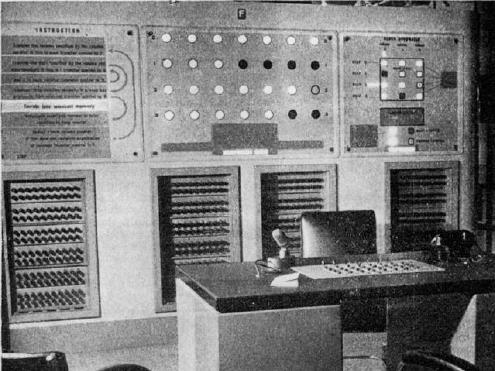
Back when the Second World War was a recent memory and folk had time on their hands and seemingly a future in which to have the time, men and women of science turned their efforts towards more trivial matters, like video gaming. In those heady days of the late Forties and early Fifties, people just had to have the latest game.
In 1951 that means you were going to play NIM, and play it on the Nimrod console, what else? There has been a few other "video game-ish" programs but they were basically lay persons adaptations of miltary programs used to shoot targets with missiles, one of the very reasons digital computers wee invented anyway. But NIM was designed to be just a game.
It debuted May 5th of that year at the Festival of Britain. This festival showcased the best of British endeavors and cutting edge science. It actually appeared at the Exhibition of Science in South Kensignton.
For those of you wondering what NIM is, its not a totally unique game made only for the computer that ran it. It was actually a NIM simulator, a small digital computer (the only kind they had then) which was perfect for it. NIM is a mathematical game usually played with stacks of objects, like match sticks, pebbles etc. Two players take turns removing amounts of objects in rotation until they are all gone. There are many, many websites out there where you try your hand at it. I played it a bit and its surprisingly satisfying for such a basic game.
Nimrod was a hit at the festival and then moved on to Berlin for a stint. The device was huge: 9 feet high by 12 feet long and contained hundreds of vacuum tubes. Everything was wired together, no plugs and sockets, so the designers had to build it correctly from the start. It wasn't actually, a flaw surfaced that caused grief for a few days, but once located it ran fine.
Blah blah blah
I have run the beer thing far enough for now, though like most of my other rants, I found out more in my snooping than I can ever hope to get on the pages of this blog the first time around. I found myself over the weekend trying to decide where to aim the mighty "Barn" ship this time, but I had a few distractions that got on my nerves.
Such as, I have a few lingering doubts about 9/11 and it bugs me that in the news again is the "other" airliner seen over Washington during the attacks. I had once hoped to do a few pages on the subject but it just got me so depressed thinking about how to approach the subject: On the one hand is the skeptic, the doubter who knows in his soul that the official reports don't add up. On the other a yearning for order and a simple plausable explanantion so we can get on with it. I'm still torn up over the Kennedy assasination and Marilyn's suicide.
I'm also feeling that Vietnam thing going on in Iraq, no matter how upbeat the reports get. I have plans for pieces on the American Civil War for 2008 and hopefully a shot at a few minor sized conflicts such as the Falklands War, the one that was never declared. Oh well.
So to keep the bow in the wind and the owls alert and ready I instead will spend a day or two in December, the final days of 2007, going on semi-knowledgably about video games.