

So in tramping around the Internet and the libraries looking for video game lore the "first video game ever" mantle steadily fell upon a quaint little game called Tennis for Two. The 2 games I wrote about in the posts were definitely out before this one, and they were real games, totally meant for distraction and amusement. So why is this one still called the first?
William Higinbotham, a scientist, developed the game to amuse visitors to Brookhaven National Laboratory on, not surprisingly, visitors day. Higinbotham was a scientist of the highest order having first worked Los Alamos National Laboratory, where like at Brookhaven he headed the electronics division. He also had a conscience, being a founding member of the Federation of American Scientists, the seminal nuclear non proliferation group.
The game itself, according to Higinbotham was pretty simple. "Back then, analog computers were used to work out all kinds of mechanical problems. They didn't have the accuracy of digital computers, which were very crude at the time, but then you didn't need a great deal of precision to play TV games. " The tiny screen, actually an oscilloscope, was connected to an analog computer programmed to play the game. The "gamer" saw a tennis court from ground level on the side with the net a vertical line in the middle, inverted T style. A dot was the ball and users used a dial to change trajectory and a switch to hit it. The program was quite cool because it played like tennis in that the ball would drop on a long shot because of gravity and a hard shot bounced back farther than a weak one.
Barely ten years later, a very similar game broke onto the scene that was actually a hit, Pong.
Wednesday, December 5, 2007
Numero Uno

Monday, December 3, 2007
Highly addictive
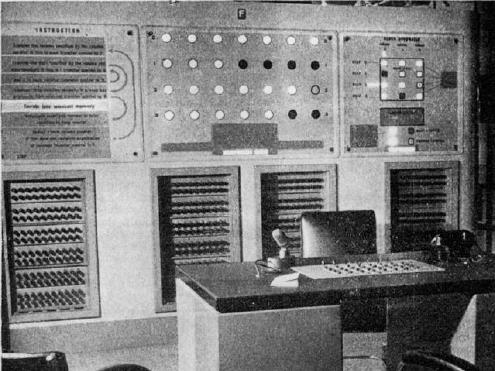
Back when the Second World War was a recent memory and folk had time on their hands and seemingly a future in which to have the time, men and women of science turned their efforts towards more trivial matters, like video gaming. In those heady days of the late Forties and early Fifties, people just had to have the latest game.
In 1951 that means you were going to play NIM, and play it on the Nimrod console, what else? There has been a few other "video game-ish" programs but they were basically lay persons adaptations of miltary programs used to shoot targets with missiles, one of the very reasons digital computers wee invented anyway. But NIM was designed to be just a game.
It debuted May 5th of that year at the Festival of Britain. This festival showcased the best of British endeavors and cutting edge science. It actually appeared at the Exhibition of Science in South Kensignton.
For those of you wondering what NIM is, its not a totally unique game made only for the computer that ran it. It was actually a NIM simulator, a small digital computer (the only kind they had then) which was perfect for it. NIM is a mathematical game usually played with stacks of objects, like match sticks, pebbles etc. Two players take turns removing amounts of objects in rotation until they are all gone. There are many, many websites out there where you try your hand at it. I played it a bit and its surprisingly satisfying for such a basic game.
Nimrod was a hit at the festival and then moved on to Berlin for a stint. The device was huge: 9 feet high by 12 feet long and contained hundreds of vacuum tubes. Everything was wired together, no plugs and sockets, so the designers had to build it correctly from the start. It wasn't actually, a flaw surfaced that caused grief for a few days, but once located it ran fine.